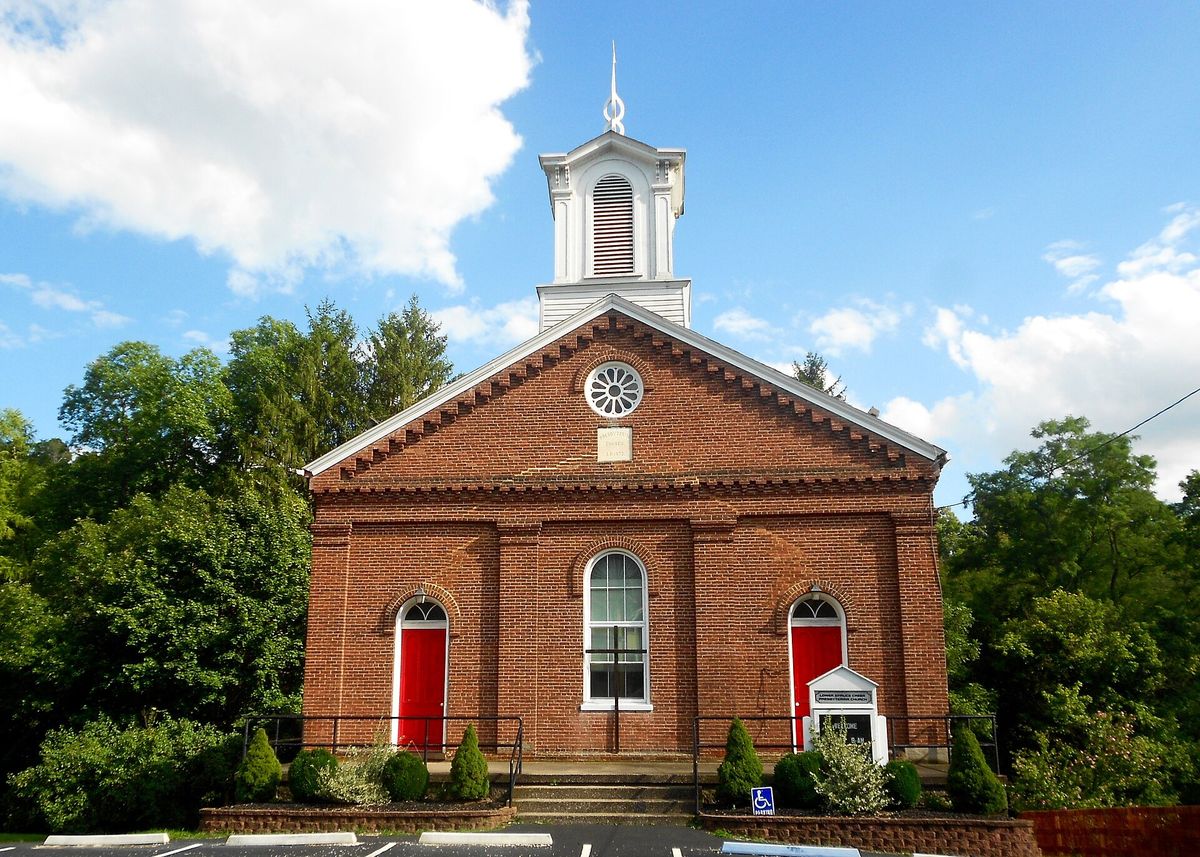

Spruce Creek township's first photograph on this site. The valley is best known outside the county for its trout water, which is why a president fished it, but the church came first and is what the township was organised around.
Township · Huntingdon County
3 stories on file, each with its sources. 8.5 square miles of land in the ridge and valley country of central Pennsylvania.
SPRUCE CREEK, a station on the railway a mile above the tunnel, is situated on both "sides of the Little Juniata, and consequently is in two townships. That part lying in Franklin contains the manufacturing interests on Spruce Creek, while the Morris part of the village has the hotel and stores of the place. In the former is a fine Presbyterian Church, while the latter contains a Methodist house of worship. The two parts are connected by a bridge, which is the third across the stream at this point, the second having been destroyed by the great flood of Oct. 8, 1847. The first bridge was erected in 1819, and the second a year before its destruction, The general interests of the two-parts are so much interblended that they are here considered as belonging to the village of Spruce Creek, in Morris. The population in 1880 was two hundred and eighteen. The first settlers in this locality were two brothers by the name of Bebault, who built a small tub-mill near the mouth of Spruce Creek, about 1775. Later the property was owned by Abraham Sells, who had in connection with his mills a public-house. Ata yet later period Jacob: Beigle purchased the mills and some six hundred acres of land from Gen. Heister, of Reading, Pa., and divided his property among his five sons, who retained ownership until 1827, when John 8. Isett secured the property, and it is yet owned by his family. J. Simpson Africa, History of Huntingdon and Blair Counties, Pennsylvania (Philadelphia: Louis H. Everts, 1883) · character 2,112,081 of the scanned text
Spruce Creek township, the youngest, but one in the county, was erected in September, 1895, from the townships of Morris, Franklin and Porter. It takes its name from the stream which empties into the Juniata river opposite the village of Spruce Creek.John W. Jordan, ed., History of the Juniata Valley and Its People (New York: Lewis Historical Publishing, 1913) · character 202,264
Quoted from a work published before 1929 and therefore in the public domain in the United States. Spelling and punctuation are as printed, including nineteenth century spellings of place names. Scanned text carries optical character recognition errors; the character offset is given so the passage can be found and checked in the original.
3 stories
Spruce Creek township's first photograph on this site. The valley is best known outside the county for its trout water, which is why a president fished it, but the church came first and is what the township was organised around.
From the county histories, on Spruce Creek township. The passage below is printed exactly as it appears in 1876, including the spelling of the day and the errors the scanner made. It has not been rewritten, summarised or added to.
The latter division is a spur usually known as the Short mountain, about two miles in length, extending from one river to the other. The Pennsylvania railroad passes through a tunnel in the northern end of it, half a mile below the village of Spruce Creek. The greater part of the township consists of an elevated plateau, to which has been given the name of Canoe valley, from the mountain enclosing it on the west. It has a fertile limestone soil, which yields generously to the hand of cultivation. One locality in this township, Water Street, is mentioned by John Harris in his "account of the road to Logstown," in 1754. The old Indian war-patb passed through it, and Conrad Weiser was there in 1748. It derived its name from the fact that a stream of water literally flowed through the street. During the Revolutionary war, General Roberdeau had a landing there, from whence lead ore, mined in Sinking valley, was shipped east to be melted, and where stores were received for the miners and troops at Fort Roberdeau. The most prosperous days of Water Street were while the Pennsylvania canal was in successful tide of operation. But since it has been closed and abandoned, the place has lost all importance, trade and travel having been diverted to points on the line of public improvements, a few miles northward. The business once attracted to Water Street by the canal is now drawn to Spruce Creek by the Pennsylvania railroad.Milton Scott Lytle, History of Huntingdon County (Lancaster: William H. Roy, 1876) · character 550,752 of the scanned text
Sources
From the county histories, on Spruce Creek township. The passage below is printed exactly as it appears in 1876, including the spelling of the day and the errors the scanner made. It has not been rewritten, summarised or added to.
Directly opposite was the mouth of a creek coming down from among the mountains and passing a short distance above its confluence with the river, through a narrow defile, which widens into a small valley, forming a level space of limited extent. The village of Spruce Creek proper, or Graysport, as it was originally named, stands on the south side of the Little Juniata, but intimately connected with the other side of the river that the two form but one community, I shall treat them accordingly. James Gray became the owner of the land on which the village is situated under a purchase from John Cannon, but the interest of the latter being afterwards sol'd at Sheriff's sale, was bought by John McCahan, of Huntingdon. A controversy arose between Gray and McCahan concerning the title, which was compromised, and a deed executed by the latter to the former on the 15th day of April, 1820. Gray had a tannery, not on the part upon which he subsequently laid out the village, but at the upper or Gray's fording, on land now owned by Michael Low. Until recently, a great willow tree stood there, which had been planted by Matthew Gray when a boy, the stump of which remains.Milton Scott Lytle, History of Huntingdon County (Lancaster: William H. Roy, 1876) · character 554,127 of the scanned text
Sources
Where it sits