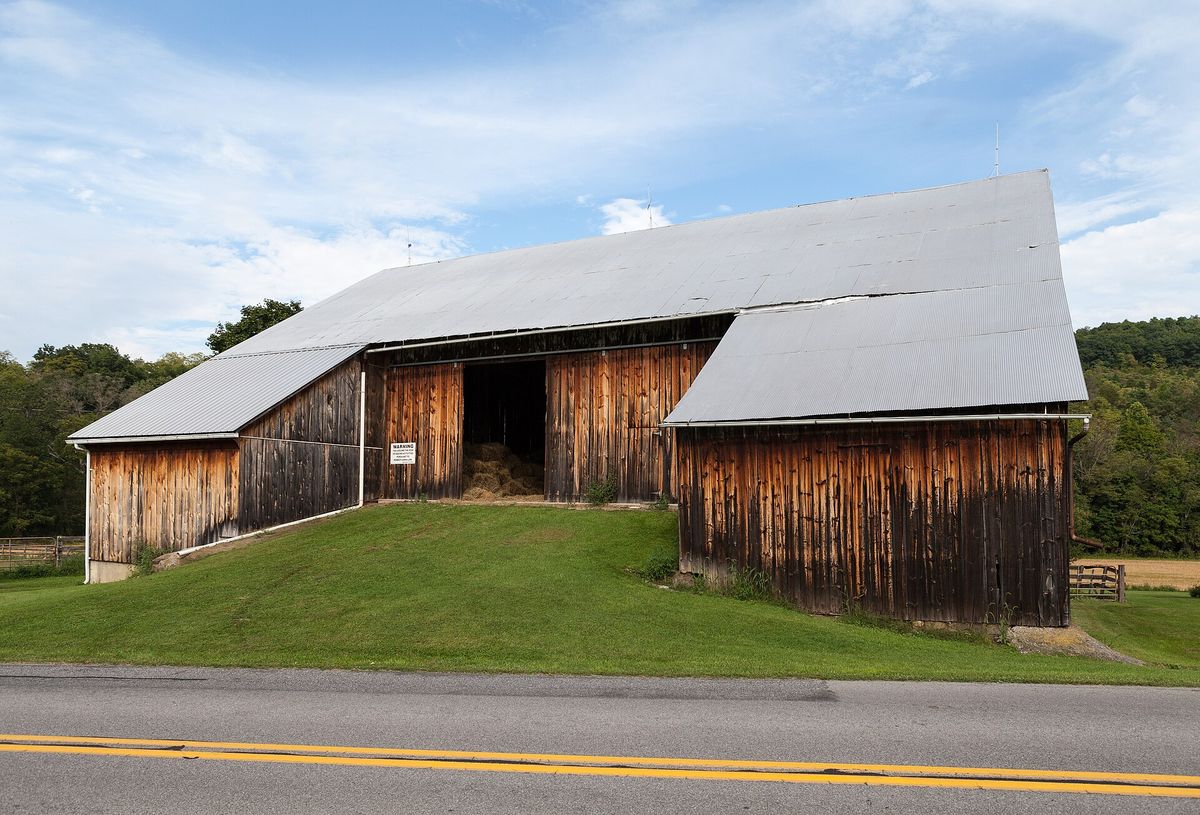
The barn at Robb Farm in Walker township, which the photographer records as a historic home and farm. Photographed in September 2014.
Township · Huntingdon County
4 stories on file, each with its sources. 18.5 square miles of land in the ridge and valley country of central Pennsylvania.
Walker township was erected from Porter in April, 1827, and the bounds of the reduced township have since been modified, the principal change being the addition of some territory from West township, extending Porter in that direction, across the Little Juniata, so as to include the Barree Forge property. J. Simpson Africa, History of Huntingdon and Blair Counties, Pennsylvania (Philadelphia: Louis H. Everts, 1883) · character 2,715,436 of the scanned text
Walker, the village having three stores in 1881, besides the drug-store of Calvin Porter, which was established in 1868. The first 427 drug-store in the village was opened by Dr. Daniel Houtz, more than a quarter of a century ago, and was continued by him a number of years, Among the keepers of public-houses was William Moore, in the low building opposite the present postoffice, about the beginning of the century. In the same house subsequent landlords were Daniel Hewitt, Thomas Lloyd, and Christiane Stemen. Farther up the street, in a building almost the counterpart of the former, was the John Walker mentioned as one of the proprietors of the stage line, and was succeeded by his son John, for many years the keeper of an inn. At later periods John H. Stackpole was the landlord, and Robert Carmon was also for a number of years the keeper of a well-known inn, occupying that building. The latter removed to Missouri, where he was elected sheriff, and was assassinated while in the discharge of his duties. In 1826, John G. Stewart opened an inn, where he now resides, which he continued about a dozen years. In the old Thomas H. Stewart house Robert Lytle had a publichouse about the time of the building of the canal, and subsequently Michael Sissler, John Odell, and Perry Robinson were kJ. Simpson Africa, History of Huntingdon and Blair Counties, Pennsylvania (Philadelphia: Louis H. Everts, 1883) · character 2,737,317
Quoted from a work published before 1929 and therefore in the public domain in the United States. Spelling and punctuation are as printed, including nineteenth century spellings of place names. Scanned text carries optical character recognition errors; the character offset is given so the passage can be found and checked in the original.
4 stories

The barn at Robb Farm in Walker township, which the photographer records as a historic home and farm. Photographed in September 2014.
From the county histories, on Walker township. The passage below is printed exactly as it appears in 1913, including the spelling of the day and the errors the scanner made. It has not been rewritten, summarised or added to.
If the location of the squatters in Walker township is correct they were doubtless the first white men who attempted to establish themselves in that section. Patterson has generally been credited with being the first settler, but in view of the above facts it is quite probable that the honor belongs to Frederick Star and his associates. Patterson was one of the most prominent of the early settlers. In he built the first grist-mill and saw-mill east of the Juniata. During the latter years of the French and Indian war his house was used as base of supplies, and at one time, in the fall of 1756, a large quantity of flour was stored there for the use of troops on the frontier. In the expulsion of the trespassers Andrew Lycon resisted arrest, for which his cabin was burned and he was taken to Carlisle and placed in jail.John W. Jordan, ed., History of the Juniata Valley and Its People (New York: Lewis Historical Publishing, 1913) · character 433,518 of the scanned text
Sources
From the county histories, on Walker township. The passage below is printed exactly as it appears in 1883, including the spelling of the day and the errors the scanner made. It has not been rewritten, summarised or added to.
Flowing into it and the main river are a number of small mountain streams whose volume becomes very small as the forests are being cleared away. In the northwestern part of the township is the mouth of- Vineyard Creek, whose flow is almost wholly in Walker township. The minor streams afford limited waterpower, which has been utilized to operate small lumber-mills, the forest products of Juniata constituting its principal source of revenue. Large quantities of bark are annually shipped from Huntingdon, which is the market of the township, both for sale and supplies, there being no hamlet or business point within its bounds. Pioneer Settlers., Although possessing so little land to invite settlements, some of the first improvements in the county were made in what is now Juniata. At the mouth of Vineyard Creek lived a Mr. Brady, the father of the Capt. Brady so greatly distinguished as a scout and Indian-fighter. His claims were probably based on possession, since these lands were warranted to other parties, and as the property of William Smith, D.D., were unimportant in the pioneer history of the county, being occupied by tenants for short periods only.J. Simpson Africa, History of Huntingdon and Blair Counties, Pennsylvania (Philadelphia: Louis H. Everts, 1883) · character 1,956,459 of the scanned text
Sources
From the county histories, on Walker township. The passage below is printed exactly as it appears in 1876, including the spelling of the day and the errors the scanner made. It has not been rewritten, summarised or added to.
Walker township extends from Piney ridge, which separates it from Juniata township on the southeast, to Tussey's mountain, dividing it from Blair county on the southwest. Its northern boundary is Porter township, and its southwestern Penn. It was named in honor of the Hon. Jonathan Walker, at one time President Judge of the judicial district to which Huntingdon county belonged. The route of travel in 1748, and previously, was through this township. A tract of land within it, lying on the Juniata river, was warranted in 1755. The site upon which McConnellstown now stands is mentioned in very early records as a "sleeping place." The town was laid out by Alexander McConnell, Esq., of HunHISTORY tingdon, after whom it was named. It is about half a mile from the Huntingdon and Broad Top railroad and contains the only post-office in the township. Additions were laid out Sangree and Joseph McCoy.Milton Scott Lytle, History of Huntingdon County (Lancaster: William H. Roy, 1876) · character 583,893 of the scanned text
Sources
Where it sits