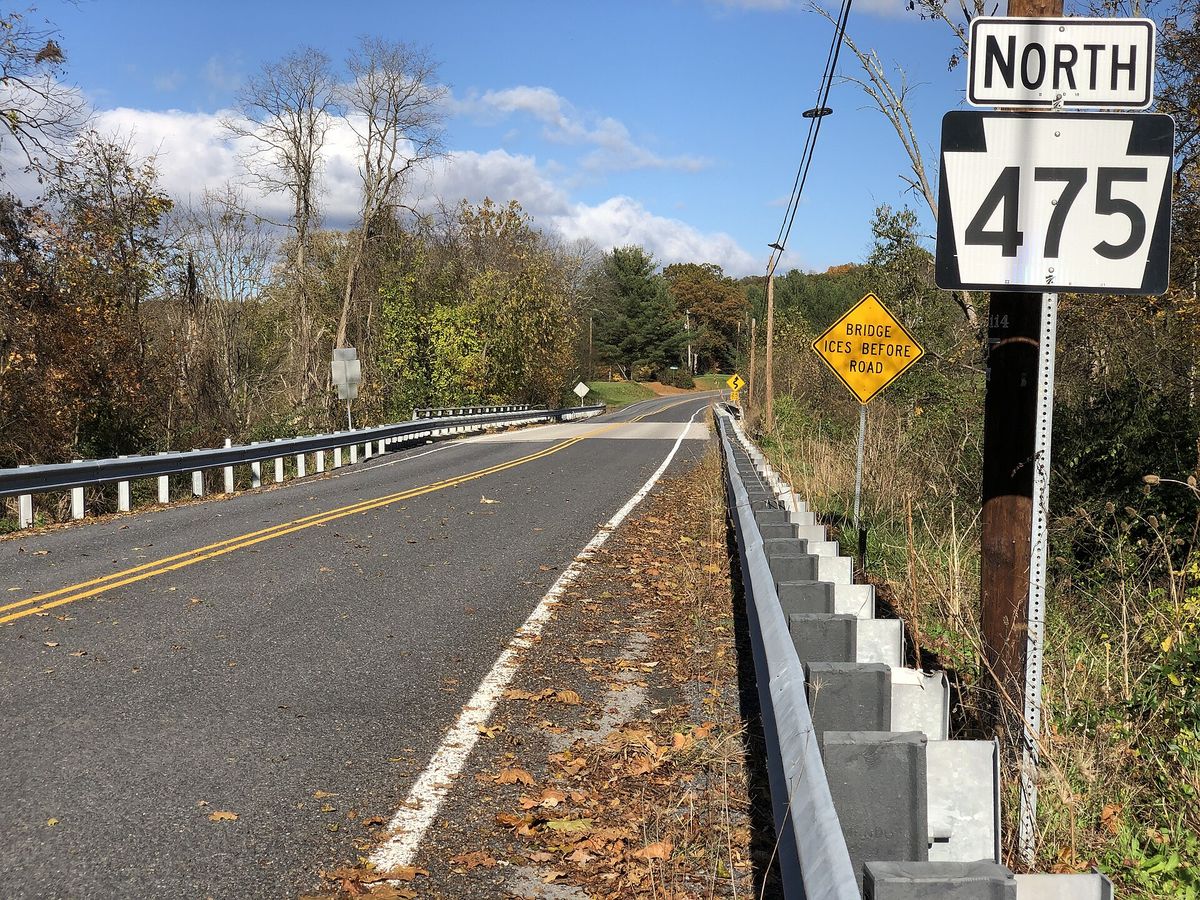
Pennsylvania Route 475, called Church Street here, looking north at Walnut Grove Church Road in Springfield township. Photographed in October 2021.
Township · Huntingdon County
3 stories on file, each with its sources. 27.5 square miles of land in the ridge and valley country of central Pennsylvania.
Springfield township, situated on the southern border of the county, was erected in 1790, from Shirley and Dublin. It is bounded on the north by Cromwell, on the east by Dublin, on the south by Fulton county, and on the west by Clay township, and contains two post-offices, Meadow Gap and Maddensville. Traversed from north to south by the Black Log mountain, the land is generally elevated and rolling, although there are considerable tracts of rich alluvial bottom along the streams, of which the principal are the Big Aughwick, Sideling Hill and Little Aughwick creeks. In the early part of the present century, Springfield township was a vast forest, slightly broken, by occassional clearings on the bottom lands. One of the earliest clearings was made by John Bailey, a Revolutionary soldier, who settled on the banks of Aughwick. The first settlers on that stream besides Bailey, were William Jones, William Ward and John Robertson, not one of whom has a representative in the township at this day. What is known as "the Big Meadow tract" was warranted, surveyed and patented at a very early day in the names of Lukens, Lennox and Woods. It is situated near the village of Meadow Gap, and contains four hundred acres. The early settlers were principally from Maryland, of which class were the Browns, Stains, Lanes, Cutshalls, etc., who are still represented by numerous descendants. Milton Scott Lytle, History of Huntingdon County (Lancaster: William H. Roy, 1876) · character 541,508 of the scanned text
Springfield township, located in the southern part of the county, was organized in December, 1790, from the townships of Dublin and Shirley. Its original area has been much reduced by the erection of Cromwell in 1836 and Clay in 1845. It is bounded on the north by Cromwell ; on the east by Dublin ; on the south by Fulton county, and on the west by the township of Clay. John Bailey, a Revolutionary soldier, settled on the banks of the Aughwick creek soon after that war. He was soon joined by William Jones, John Robertson and William Ward. Then came a tide of immigration from Maryland, the Browns, Maddens, Ramseys, Lanes, Cutshalls, Wibles, and several other families locating in what is now Springfield township. Thomas Stains settled where the village of Meadow Gap is now, and the village of Maddensville bears the name of one of these pioneer families.John W. Jordan, ed., History of the Juniata Valley and Its People (New York: Lewis Historical Publishing, 1913) · character 201,401
Quoted from a work published before 1929 and therefore in the public domain in the United States. Spelling and punctuation are as printed, including nineteenth century spellings of place names. Scanned text carries optical character recognition errors; the character offset is given so the passage can be found and checked in the original.
3 stories

Pennsylvania Route 475, called Church Street here, looking north at Walnut Grove Church Road in Springfield township. Photographed in October 2021.
From the county histories, on Springfield township. The passage below is printed exactly as it appears in 1913, including the spelling of the day and the errors the scanner made. It has not been rewritten, summarised or added to.
A small log house was built, but was abandoned in a few years, the members going to strengthen another congregation on Licking creek, near the old forge. An Old School Baptist congregation was organized in Springfield township, Huntingdon county, in 1800, but little can be learned of its history. A number of Welsh Baptists organized a church at an early date near the present borough of Dudley, but it has long been extinct. The church at Birmingham was organized in by Rev, Richard Proudfoot, who had been holding meetings in that section for some time before that date. About a church was erected and it prospered for a number of years. After the completion of the railroad the business that formerly came to Birmingham was diverted to other places, and as the town declined the church went down until it was finally abandoned in 1862. Rev. Samuel Lane, a Baptist minister "of more than ordinary energ>- and public spirit," established a church at Saltillo early in the nineteenth century, but it appears that no record of the congregation has been preserved, either as to the date of its organization or its abandonment. The Shaver's Creek Baptist church was organized in 1833, with fourteen members, as a result of the labors of Rev. Richard Proudfoot, who was the first pastor.John W. Jordan, ed., History of the Juniata Valley and Its People (New York: Lewis Historical Publishing, 1913) · character 894,573 of the scanned text
Sources
From the county histories, on Springfield township. The passage below is printed exactly as it appears in 1883, including the spelling of the day and the errors the scanner made. It has not been rewritten, summarised or added to.
Owing to its distance from public improvements, and consequent isolation from the outer world, this township has never been favored with manufacturing establishments, that it otherwise would have been with all its natural advantages. Probably the pioneer settler of what is now Springfield township was a Revolutionary soldier by the name of John Bailey, who wandered along down the Little Aughwick till near what is now Maddensville, where he selected a spot, cut away the trees, and built his mansion. He was not long "alone in his glory," for soon came along a few more hardy pioneers in search of future homes, among whom we find William Ward, John Robertson, and William Jones, who located along the banks of the Aughwick. These pioneers were soon reinforced by others, among whom were the Cutshalls and Stains, Browns and Lanes, the Wibles, the Ramseys and Maddens. The Wibles were of German descent, while the two latter descended from Erin's green isle. All these pioneers located along the Aughwick Valley, while Hugh Orlton, who descended from the Scottish highlands, thought there was no place like the hills, and became pioneer of the hill country, out of reach of the next flood. He took up a large tract by warrant or patent, and subsequently sold to Richard Lane. Mr. Orlton had the pleasure and honor of owning the pioneer "7" shingle-roof" house in the township.J. Simpson Africa, History of Huntingdon and Blair Counties, Pennsylvania (Philadelphia: Louis H. Everts, 1883) · character 2,338,483 of the scanned text
Sources
Where it sits