Brady township, Mapleton borough
Brady Township's Glass Sand
Did you know? Sandstone of superior quality for making glass came from Rocky Ridge in Brady Township. In 1854 Ulrey, King and Company began quarrying sandstone for glass, shipping the crude stone to Pittsburgh, where, after it was reduced, the sand was found to be of superior quality.
Mr. King of Pittsburgh and Elliott Robley and D. H. Foster of Brady then experimented with crushing the stone at the quarry itself. A machine driven by steam power was finally devised and successfully set to work in 1857.
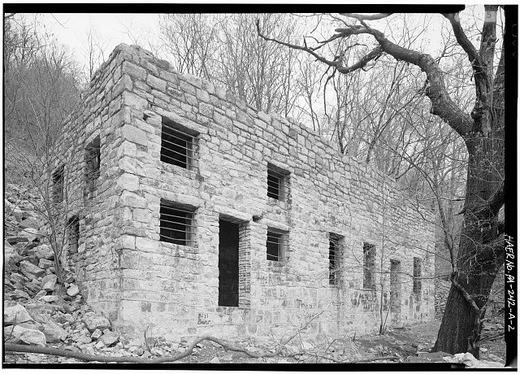
The township also had an iron furnace. Mill Creek Furnace, built in 1838, employed about one hundred and twenty men when fully operated, and more than forty houses were built in Brady for its workers. Its ore was chiefly brought from Franklin Township by canal and later by railroad, and nearly all its metal was taken to Barree Forge. Its first firm failed in 1842, and later owners ran it until 1857, when the remaining stock was placed in the hands of trustees, and the business closed up in March 1858. The Huntingdon Journal of November 25, 1857, had already put it in one word among its short items, "Busted," naming the owners as Irvin, Green and Company.
E. A. Green and Company put the furnace back in blast in 1863, but it blew out after six years. The sources differ on the firm's name: J. Simpson Africa's 1883 county history gives E. A. Green, while a Bellefonte court report reprinted in the Huntingdon Journal of May 27, 1874, gives E. H. Green. That report, going by the testimony, says the firm was formed in 1863 and became insolvent in 1869. The Globe of Huntingdon advertised a public sale at the furnace for March 12, 1870, offering horses, wagons, and ore bank and furnace tools. The furnace was still idle when Africa's history appeared in 1883, and the history says that since the furnace stopped, quarrying and crushing sandstone for glass had been the principal industry of the township.
The glass sand plants at Mapleton, across the river from Brady Township, came together under the Pennsylvania Glass Sand Company. The sources do not agree on its start date. A 1991 National Park Service inventory of the county's historic engineering and industrial sites and the 1966 Mapleton Centennial history both say 1902. U.S. Silica, which the company later merged into, dates the company to 1894 in its own history. A 1918 state report says a company of that name controlled the glass sand plants in the Juniata Valley in 1899.
The inventory places the company's Keystone plant north of the river, in Brady Township, and dates it to 1923 and 1924.
Sources
- J. Simpson Africa, History of Huntingdon and Blair Counties, 1883, pp. 218 to 224: Brady Township, Mill Creek Furnace and the glass sand quarries
- Nancy S. Shedd, Huntingdon County, Pennsylvania: An Inventory of Historic Engineering and Industrial Sites, National Park Service, 1991, pp. 113 to 115: Keystone Works entry
- Mapleton Centennial, 1866-1966, July 1966: The Sand Industry, by C. H. Dell
- Charles R. Fettke, Glass Manufacture and the Glass Sand Industry of Pennsylvania, Topographic and Geologic Survey of Pennsylvania Report No. XII, 1918, pp. 192 to 211: Huntingdon and Mifflin county histories
- U.S. Silica, company history timeline, accessed November 1, 2026: founding, name change and merger dates
- Huntingdon Journal, November 25, 1857, page 3: short item on Mill Creek Furnace
- The Globe, Huntingdon, March 2, 1870, page 3: notice of public sale at Mill Creek Furnace
- The Huntingdon Journal, May 27, 1874, page 3: court report from the Bellefonte Republican on the furnace firm
- The Huntingdon Journal, March 21, 1879, page 2: sheriff's sale of the Mill Creek Furnace property
Checked 2026-10-30 · County histories and primary sources, read in full
← All stories from Brady township
Have something to add to this story, or a photograph of it? Send it here →
Photographs from Brady township
More from Brady township
The Mapleton centennial book of 1966 says Marion Samuel Cree, a native of the town, spent the last 17 years of his life…
Mapleton borough, The Flea Bite at Newton HamiltonOn Christmas Day 1879, B. E. Morrison began a four-page newspaper in Newton Hamilton. The 1886 history of the…
Mapleton borough, The Clairndon Hotel at MapletonThe Clairndon Hotel stood in the center of Mapleton. The town's 1966 centennial book says it was built about 1905, and…
Also about County history
Two early stone houses in Mount Union have both been called the oldest, each within its own place. Charles Howard…
elsewhere in the county, A Book of Poems, 1909Before he wrote his history of Mount Union, Charles Howard Welch brought out a book of poems. The title page reads A…