Mount Union borough
The Dust
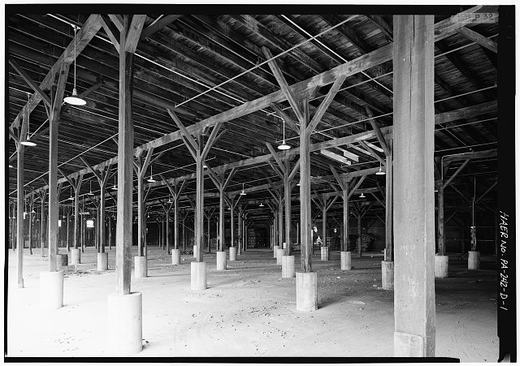
This is the inside of the packing shed at the No. 1 works. Every one of those posts is doing a job, and the floor runs on past the end of the photograph.
It is also worth being honest about what the work cost. Silica yards were harder on a man than fire clay yards, because the air carried a far heavier load of silica dust, and silica dust causes silicosis. The men in crushing, in grinding and in shipping breathed the worst of it. Pennsylvania's own Bureau of Industrial Hygiene published a study of silicosis in the silica brick industry in 1941, so this was known.
Thousands of brickyard workers across this region got it. By the time it was formally accepted in the late 1960s as a product of the working conditions, the companies had become offices in far away cities, and a man or his widow had to find a doctor who would certify it and a lawyer who would carry the dust claim.
We should not tell the story of this town without that part in it.
Sources
- HABS PA-5973 p.21 (silicosis, exposure by work area)
- HABS PA-5973 p.39 (dust claims, recognition in the late 1960s)
- Fulton et al., A Study of Silicosis in the Silica Brick Industry, PA Dept of Health, 1941
- LOC caption pa2727.photos.134465p
Checked 2026-09-13 · Historic Mount Union collection
More from Mount Union borough
This stone house stands on West Water Street near Division. The federal survey records it as the John Sharrar House and…
Mount Union boroughThe Brick Office that Became the Red CrossLook at the sign in the yard. This little brick building on Market Street was the General Refractories Company office.…
Mount Union boroughAetna Explosion 1916Did you know? The building that killed six men at Mount Union had been catching fire all summer, and the paper reported…