Mount Union borough
Strickler's Store and Gas Station
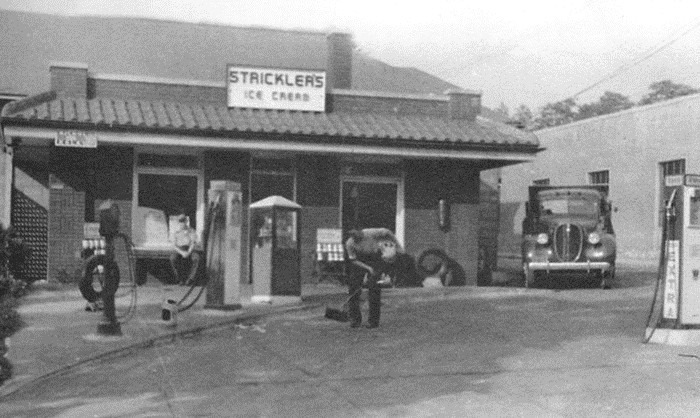
Strickler's in the 1950s, full service in every way: pump your gas, fix your car, sell you a cold drink, and maybe a sandwich for the road. By the 1960s, these corner stores were vanishing, replaced by gas stations and convenience chains that didn't know your name.
From the record
Passages about this subject, quoted from county histories now in the public domain. Each one names the book and the position in the text so it can be checked. Spelling is as printed.
Knowing the power of printer's ink, these pioneer tablets were advertised to the stationery trade, and met with a cordial reception. A little later on, noticing some colored lithographic signs in a furniture store window, he conceived the idea of adding a decorated cover to the here-to-fore plain tablets. Trying out this plan proved a great success and the little store room "in the Diamond" at 422 Penn street was abandoned in 1881 for the Presbyterian church building at Sixth and Penn. Out-growing this, in turn, the large five-story brick building at Sixth and Allegheny streets was built and occupied during 1884. Then the foundation and a part of the walls of the old church were included, during 1889, in the eight-story brick building which covers one hundred foot frontage on Penn street. The bush 188 ness, still increasing, having out-grown the original conditions, the founder, with a desire to perpetuate this monument of his business zeal and ability, created the J. C. Blair Company, by incorporating under the laws of Pennsylvania on May 22nd, 1891. Thus providing for future developments and enlargements of the business.Historic Huntingdon, 1767-1909 · character 305,857 of the scanned text
Lodges of various benevolent societies are located here ; Juniata Grange, Patrons of Husbandry, was organized in 1874; there are churches of different faiths, the Shaver's Creek Bank, several good stores and in 1910 the population was reported as being 705. Rock Hill (postoffice name Rockhill Furnace) was laid out in 1874 across the Black Log creek from Orbisonia. A large number of the early houses were built and owned by the Rockhill Iron and Coal Company. An iron furnace was opened at this place in 1831 by Diven & Morrison. The Winchester furnace was built two or three years later. Rock Hill was incorporated on June 16, 1887, with A. W. Sims as the first chief burgess. It is a station on the East Broad Top railroad and in 1910 reported a population of 504. Saltillo, a station on the East Broad Top railroad in the southern part of the county, was settled in 1796 by Henry Hubbell. On August 20, 1796, Thomas Greer filed for record the plat of "Springville," which occupied the site of Saltillo. A grist mill was built by Henry Hubbell in 1797 and J. & J. C. Brewster were the first merchants. A number of lots were sold to people in Philadelphia and other places, but the lack of transportation facilities caused many of the purchasers to surrender their claims and Springville died a natural death.John W. Jordan, ed., History of the Juniata Valley and Its People (New York: Lewis Historical Publishing, 1913) · character 232,854 of the scanned text
Few boroughs in the state show as great an increase in population and wealth during the last twenty years as Mount Union, Orbisonia, a station on the East Broad Top railroad, which connects with the Pennsylvania at Mount Union, is the largest town in the southeastern part of the county. As early as 1760 George Irvin had an Indian trading post at this point. The Bedford furnace was opened in 1785 and two years later a grist mill was started. Another mill was built by Hezekiah Crownover in 1812. The store of Cromwell & Cornelius was opened in 1824, a postoffice was established in 1830 in Taylor Crownover's store, there were two distilleries in 1833 and in 1836 Jonathan Carothers opened the Eagle Hotel. Up to this time the town, like Topsy in Uncle Tom's Cabin, "just growed." There were no streets and the lots were of irregular size, straggling along on either side of the road. In May, 1850, it was regularly laid out and named Orbisonia, for Thomas E. Orbison, who located there about 1830 or 1831. The growth of the town continued and on November 23, 1855, it was incorporated as a borough, with Simon Gratz as the first chief burgess. Orbisonia has two banks, a weekly newspaper, churches of different denominations, a good retail trade with the surrounding country and in 1910 the population was 618.John W. Jordan, ed., History of the Juniata Valley and Its People (New York: Lewis Historical Publishing, 1913) · character 230,296 of the scanned text
Sources
- catalog h39 facts
- Photograph credit: huntingdoncountyhistory.com
Checked 2026-08-05 · Historic Mount Union collection
More from Mount Union borough
This stone house stands on West Water Street near Division. The federal survey records it as the John Sharrar House and…
Mount Union boroughThe Brick Office that Became the Red CrossLook at the sign in the yard. This little brick building on Market Street was the General Refractories Company office.…
Mount Union boroughAetna Explosion 1916Did you know? The building that killed six men at Mount Union had been catching fire all summer, and the paper reported…