Mount Union borough
The beehive ovens
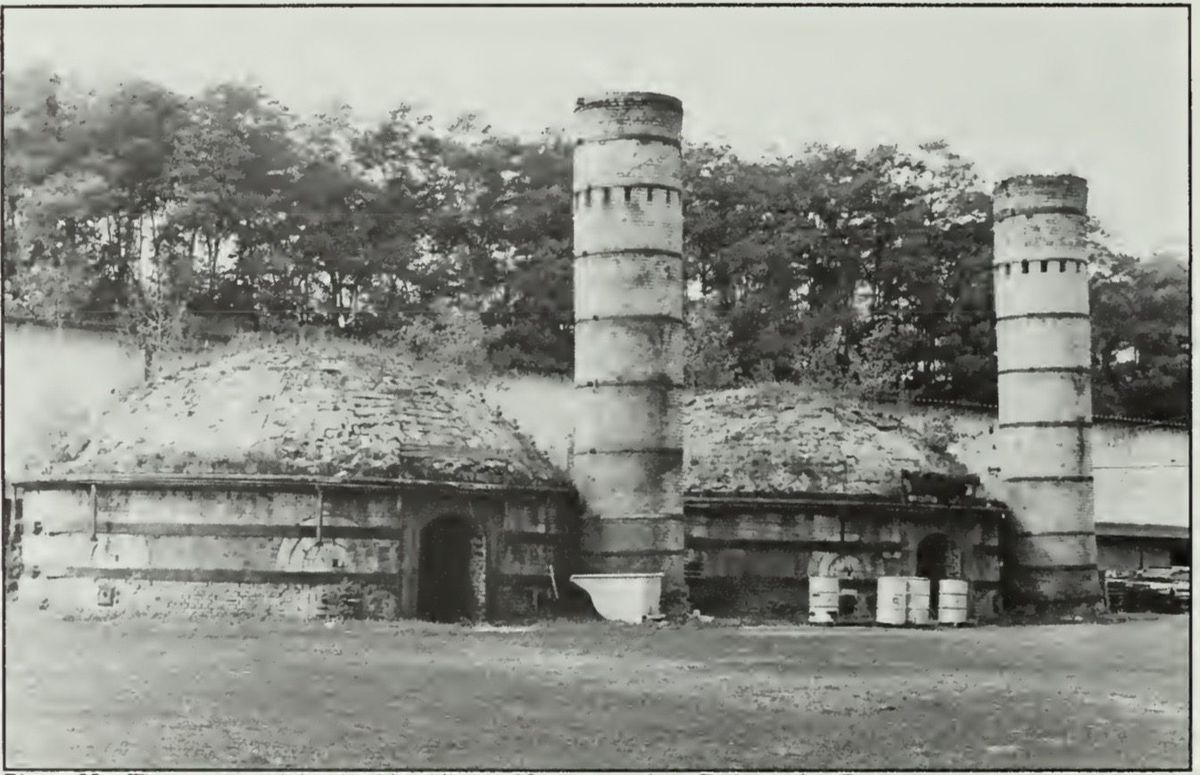

The beehive ovens of the Mount Union Refractories Company. Two former Harbison-Walker managers struck out on their own in 1911 and built this plant on the edge of town, eight kilns to start, twenty-one more added during World War I. That's how much the world wanted Mount Union brick.
From the record
Passages about this subject, quoted from county histories now in the public domain. Each one names the book and the position in the text so it can be checked. Spelling is as printed.
Other Huntingdon manufactories are turning out iron wares, sewer pipes, etc., but perhaps the business that has done more than any other to advertise Huntingdon to the outside world is the J. C. Blair Company, manufacturing stationers. John C. Blair, the founder of the business, was the first man in the world to put up stationery in the form of tablets, to which he soon after added the decorated covers. He began in 1878 in a small store room at 422 Penn street, which was abandoned in 18S1 for the old Presbyterian church. Three years later a five-story brick building was erected at Sixth and Allegheny streets, and in 1889 an eight-story building was put up and in May, 1891, the business was incorporated. The company employs about 250 people and its annual product reaches about $1,000,000, the Blair tablets going all over the world. A recent industry of the Juniata valley that is attracting considerable attention is the Suskana Silk Works of Lewistown, which were established in 1909. The plant at this point is one of a chain of six mills in the United States, the others being in New York City, two at Sunbury, Pennsylvania, Marion, Ohio, and Jersey Shore, Permsylvania. The business was originally established in Germany about 1784 and this branch of the silk manufacturing industry is controlled by the Schniewind family, which also has eight mills in Germany.John W. Jordan, ed., History of the Juniata Valley and Its People (New York: Lewis Historical Publishing, 1913) · character 747,046 of the scanned text
Its founder, John Chalmers Blair, engaged in the business of books and stationery in the borough between the years of 1865 and 1878. During the summer of the year last named, believing that writing and print papers could be marketed to better advantage when put up in tablet form, as against the loose, or folded, sheets, he made a number of varieties as an experiment. Knowing the power of printer's ink, these pioneer tablets were advertised to the stationery trade, and met with a cordial reception. A little later on, noticing some colored lithographic signs in a furniture store window, he conceived the idea of adding a decorated cover to the here-to-fore plain tablets. Trying out this plan proved a great success and the little store room "in the Diamond" at 422 Penn street was abandoned in 1881 for the Presbyterian church building at Sixth and Penn. Out-growing this, in turn, the large five-story brick building at Sixth and Allegheny streets was built and occupied during 1884. Then the foundation and a part of the walls of the old church were included, during 1889, in the eight-story brick building which covers one hundred foot frontage on Penn street.Historic Huntingdon, 1767-1909 · character 305,399 of the scanned text
The only private schools now in existence in the county are the Huntingdon Academy and the Mountain Seminary at Birmingham. The former was incorporated by Act of Assembly of March 19th, 1816, which also granted a donation of $2,000 to the institution. It continued to receive State aid for a number of years. The buildings, then situated at the southeastern corner of Second and Allegheny streets, known as Dean's Hotel, were purchased, and used for the school for many years. The brick building at the corner of Fourth and Moore streets was erected in 1844, and the school removed there. In 1874 a more commodious structure was placed at the northeastern corner of Fourth and Church streets. Professor J. A. Stephens was then the principal, and it was his efforts and energy that secured its erection. His health failing, he was able to teach but a short time in the new building. He died in April, 1876, much lamented by all who knew him. W. Campbell is the present principal. The Mountain Seminary was incorporated in 1851, and the buildings erected by a stock company. Rev.Milton Scott Lytle, History of Huntingdon County (Lancaster: William H. Roy, 1876) · character 343,633 of the scanned text
Sources
No source list was recorded with this item when it was written. It is shown here as written and has not been re-verified. Treat it as unverified until it has been.
Checked 2026-07-19 · Historic Mount Union collection
More from Mount Union borough
This stone house stands on West Water Street near Division. The federal survey records it as the John Sharrar House and…
Mount Union boroughThe Brick Office that Became the Red CrossLook at the sign in the yard. This little brick building on Market Street was the General Refractories Company office.…
Mount Union boroughAetna Explosion 1916Did you know? The building that killed six men at Mount Union had been catching fire all summer, and the paper reported…