Mount Union borough
Twenty Days to Burn a Brick
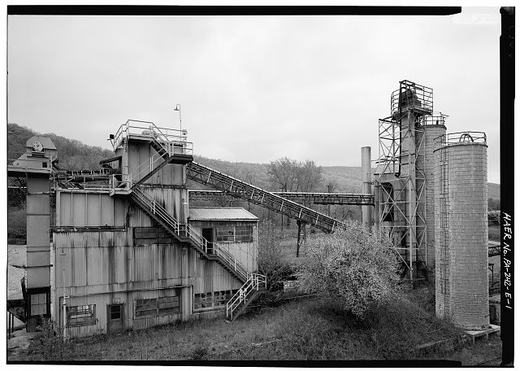
A green brick holds so much water that it would blow apart in the kiln, so before anything else it had to be dried. Left in the yard that took days and depended entirely on the weather. The yards fixed that by running flues under the drying floors, and later by circulating steam and waste heat off the kilns. This is the rotary dryer and its conveyors.
Then the burning. Setters stacked the bricks inside the kiln in patterns worked out so the heat could get everywhere evenly, the door was bricked shut, and the firemen brought the temperature up over a period of days to more than two thousand degrees. Then they had to bring it back down just as slowly. A single firing cycle could run twenty days, with loading and unloading on either end of that.
Twenty days, for one kiln of brick, done by men who knew by feel when it was right.
From the record
Passages about this subject, quoted from county histories now in the public domain. Each one names the book and the position in the text so it can be checked. Spelling is as printed.
It was again revived in 1839, when the debt amounted to one thousand nine hundred and forty- three dollars and twenty-five cents. The lots were then sold at Sheriff's Sale, and bought by the county commissioners for one thousand dollars. A scire facias was issued on the Drury mortgage in the same year and judgment obtained for three hundred and twenty-five dollars and fifty cents, on which the lot was sold, and bought by the commissioners. A court house was erected upon these lots, the front line being in the rear of the Cadwallader mansion which 78 was used by the carpenters during the progress of the new building, as a workshop. This building, two stories in height, completed and occupied in August, 1842, was constructed in the shape of a T and had a court room and offices for the prothonotary and register and recorder on the lower floor, the offices being in the wings. The commissioners' office was on the second floor, immediately over the recorder's office and the grand jury room over the prothonotary's office. Other rooms on the second floor were appropriated to the use of the treasurer, sheriff, county surveyor, and traverse juries. James and Robert Stitt were the contractors. Most of the bricks used in the construction of the building were made and burned on the grounds.Historic Huntingdon, 1767-1909 · character 132,706 of the scanned text
Proposals for the grading and masonry between Lewistown and Huntingdon were advertised for in April, 1818, and received until the 17th of May. Contracts were entered into within the next twenty days, and the work was at once commenced. At the close of tbe year the grading was almost completed. The sections west of Huntingdon were in process of construction during the same year and the one succeeding it. HISTORY OP HUNTINGDON" COUNTY. 149 On the tunnel near Spruce Creek, eleven hundred feet in length, great labor was required. An opening was effected through the mountain in June, 1849, eleven months after the first pick had been struck into it. But only three hundred and fifty feet were at that time finished. Several serious accidents occurred at this tunnel from the premature explosion of blasts. In one of these, seven men were blown up, one of whom was killed and two others so badly injured that they were not expected to recover. - In the neighborhood of Birmingham there were a number of riots among the laborers on the road in 1849. The Irish workmen were divided into several parties known as the u Far-downs," " Corkonians," etc., each determined to drive the others from the line.Milton Scott Lytle, History of Huntingdon County (Lancaster: William H. Roy, 1876) · character 285,677 of the scanned text
At the time the village was laid out there were about 141 twenty houses there and a tavern had been conducted for many years. A large brick hotel was built soon after the town was laid out. Reedsville is also connected with Lewistown by electric railway. It has a bank, the Brown township high school, several good stores, hotel, etc., and is supplied with water by the Lewistown Water Company. Wagner, a station on the Sunbury division of the Pennsylvania railroad, had its beginning in 1868, when the railroad was completed, A tan-yard had been started there in 1853 by William Mitchell & Son, and doubtless had some influence in securing the location of a station. Soon after the railroad was opened for business a postofiice was established and a store opened. Yeagertown, situated on the Kishacoquillas creek, about a mile above Bumham, and connected with Lewistown and other points along the Kishacoquillas by electric railway, is the outgrowth of a settlement that grew up about the saw-mill and grist-mill erected there at an early date. James Mayes settled in that section in 1790 and built a tavern which was kept by different persons for many years. In 1842 Jacob Yeager came with his family from Dauphin county and purchased the mill property.John W. Jordan, ed., History of the Juniata Valley and Its People (New York: Lewis Historical Publishing, 1913) · character 354,308 of the scanned text
Sources
- HABS PA-5973 pp.11-12, 14 (drying, firing cycle, hot floors)
- LOC caption pa2728.photos.134466p
Checked 2026-09-16 · Historic Mount Union collection
More from Mount Union borough
This stone house stands on West Water Street near Division. The federal survey records it as the John Sharrar House and…
Mount Union boroughThe Brick Office that Became the Red CrossLook at the sign in the yard. This little brick building on Market Street was the General Refractories Company office.…
Mount Union boroughAetna Explosion 1916Did you know? The building that killed six men at Mount Union had been catching fire all summer, and the paper reported…