Mount Union borough
What the Company Called This Place in 1917
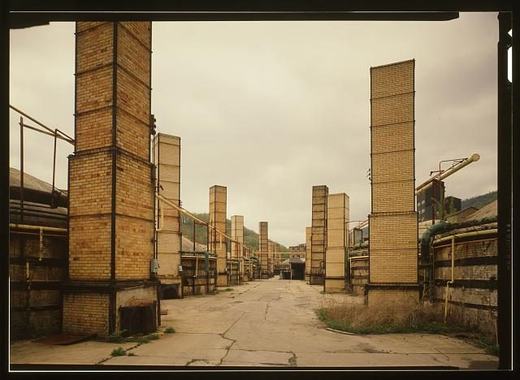
In a 1917 advertisement, Harbison-Walker called itself the largest manufacturer of refractory materials in the world, and called its Mount Union operation the largest silica brick plant in the world.
Those were the company's own words about itself, and the federal survey quotes them as such. What the survey states in its own voice is more than enough: by 1910 the plant employed more than six hundred men and could produce 150,000 bricks a day.
This is a rare color photograph looking south down the No. 2 kilns. That pale cream color in the stacks is not the light. That is what silica brick looks like.
Before this happened
The county histories on file were printed in 1847, 1876, 1883, 1897, 1909 and 1913, so none of them can describe an event of 1917. What they can do is describe this same place and these same firms beforehand. These passages are background, not corroboration. Each names the book and the position in the text so it can be checked. Spelling is as printed.
The high and mighty States-General of Holland in 1614 issued an edict granting to persons who had or should thereafter discover "any new courses, havens, countries, or places" the exclusive privilege of resorting to and frequenting the same for four voyages. Under this edict the merchants of Amsterdam fitted out several vessels for the purpose of exploration. One of these was commanded by Capt. Cornelius Jacobsen Mey, who entered the Delaware Bay. He gave his own name to the northern cape, now called Cape May, anl to the southern the name Cape Cornelius, now known as Henlopen. No settlement was made on the Delaware until 1623, when under the auspices of the West India Company, chartered in 1621, Capt. Mey ascended the Delaware, and on the eastern side, about Gloucester Point, commenced the erection of Fort Nassau, intended for a trading-post, as well as for security against the Indians. This effort was not successful. The fort was soon abandoned, for we are informed by De Vries, who visited it in 1633, that it was then in the possession of the Indians. Peter Minuit, in 1637, under the patronage of Christiana, Queen of Sweden, with two vessels and a number of settlers, crossed the Atlantic, and after touching at Jamestown, Va., reached the Delaware about May, 1638.J. Simpson Africa, History of Huntingdon and Blair Counties, Pennsylvania (Philadelphia: Louis H. Everts, 1883) · character 23,332 of the scanned text
On these conditions the Cabbin, by my Order, was burnt by the Under-Sheriff and Company."* At Aughwick, (now Shirleysburg) Peter Falconer, Nicholas DeLong, Samuel Perry and John Charleton were convicted on the view of the magistrates, entered into recognizances for their appearance at the next county court at Shippensburg, and gave bonds to remove with their families, servants, cattle and effects. Charleton's cabin was burned, and another in the course of erection, consisting of only a few logs piled and fastened together, was set on fire. One of the places where this destruction occurred, near the line between Huntingdon and Fulton counties, is called Burnt Cabins, a name it will probably retain until the history of these events becomes as obscure as the history of the savage race. The protection of all lands from encroachment that had ^Secretary Peters' Report. 38 HISTORY OF HUNTINGDON COUNTY. not been bought by the proprietaries from the Indians, was a part of the policy instituted at the founding of the province, a policy which secured harmony and good feeling between the whites and natives as long as it was not interfered with by extraneous influences, but the success of which was coming to an end.Milton Scott Lytle, History of Huntingdon County (Lancaster: William H. Roy, 1876) · character 64,678 of the scanned text
Bob Orr, of Kishacoquillas, gave me a small neat black horse of four years old and a half for my old companion " Jack." " Having adjusted matters I left town in company with Mr. Clugage, and rode down the river, a stony path, through Jack's Narrows, where the high mountains on each side of the water came down to its very bank. So that in places we were forced to go down on the water's edge. We crossed over the water. ‘This is one end of Hell Valley,' said Mr. Clugage to me, as we were jogging along in silence, about ten miles onward is a gap between the hills which is called the Shades of Death. What! are the shadows of death and hell here? Death and hell so easily passed through! Vain man, how daring to make these tremendous subjects so common. We crossed Of wick (Aughwick) Creek and arrived about eight in the evening at Mr. Fowley's who lives within the walls of old Fort Shirley. Distance from town twenty miles. "Wednesday, August 23d.^-I had almost forgotten to tell the person who shall read these pages a couple of hundred years hence that there is now standing in a garden at Huntingdon a tall stone column or pillar nearly square, which has given to the town and valley the name of ‘Standing Stone Valley.' The column is seven feet above the ground. "After breakfast with Mrs.Historic Huntingdon, 1767-1909 · character 96,676 of the scanned text
Sources
- HAER PA-242 p.2 (1917 advertisement; 600 men; 150,000 bricks per day)
- LOC caption pa2723.color.572389c
Checked 2026-09-14 · Historic Mount Union collection
More from Mount Union borough
This stone house stands on West Water Street near Division. The federal survey records it as the John Sharrar House and…
Mount Union boroughThe Brick Office that Became the Red CrossLook at the sign in the yard. This little brick building on Market Street was the General Refractories Company office.…
Mount Union boroughAetna Explosion 1916Did you know? The building that killed six men at Mount Union had been catching fire all summer, and the paper reported…